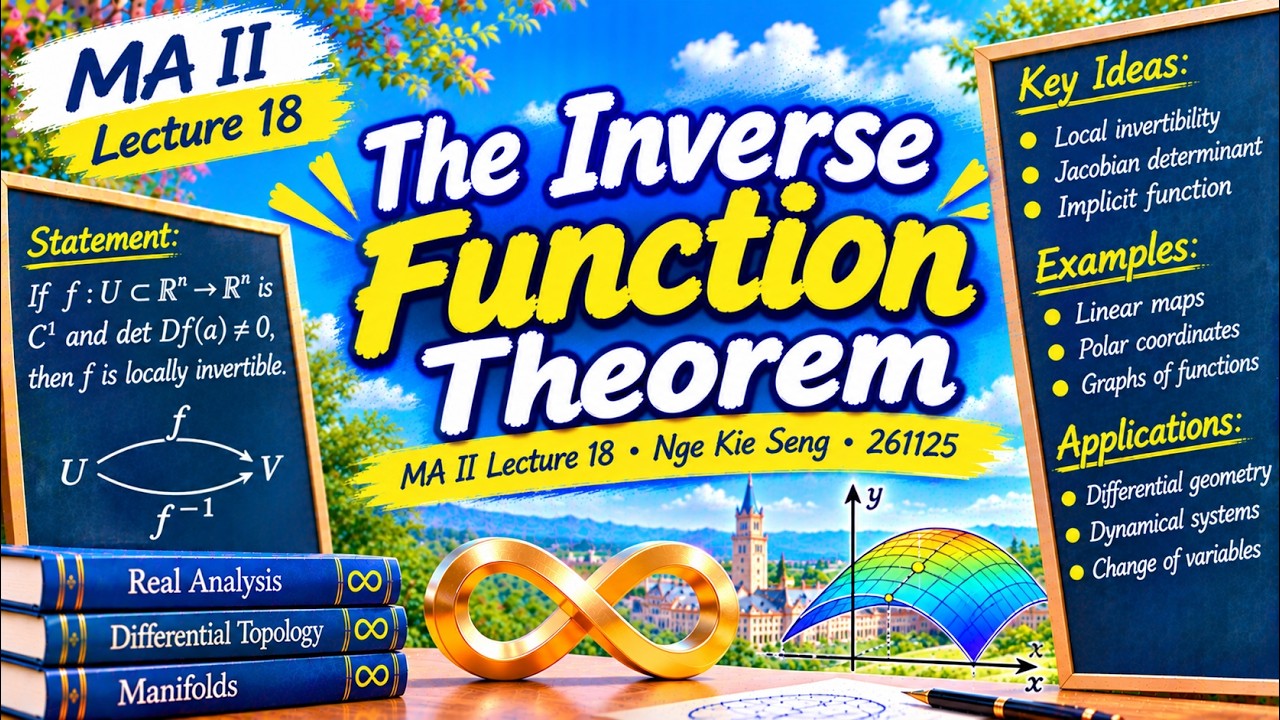
The Inverse Function Theorem | MA II Lecture 18 | Nge Kie Seng 261125
Keywords
Summary
310 words
Critical Evaluation
Value of the Information & Strength of the Argument
The informational value lies in synthesis rather than novelty. Within a single session the instructor ties together three layers that are usually taught separately: linear algebra (invertibility is an open property, quadratic forms and their lower bounds), one-variable calculus (the discriminant condition of the classical maximum/minimum test), and multivariable analysis (Taylor expansion, Hessian, inverse function theorem). The identification of the calculus-2 quantity D with the determinant of the 2x2 Hessian, and of the sign conditions on f_xx and D with positive definiteness, is the clearest pedagogical payoff of the recording and is developed explicitly rather than merely asserted. The reinterpretation of the gradient as an instrument for extending a function locally, and of higher-order derivatives as the successive terms of a Taylor series, is a genuine conceptual reframing that adds value beyond a statement of theorems.
The argumentation is deductive and follows a coherent plan: statement, proof, corollary, then reuse of the result in the next theorem. The second-order test is proved for the positive definite case only, with the negative case obtained by a symmetry argument explicitly flagged, which is methodologically clean. The proof of the open image lemma proceeds by the standard strategy of locating a ball inside the image, using stability to control the boundary and then the extreme value theorem to control the interior. Two limits should be noted. First, the argument is sketched orally and several key transitions are worked out by trial and error in front of the audience, with wrong signs corrected mid-sentence and the choice between radii c·r and c·r/2 left to be tested against the inequalities; this is honest but makes the written trace hard to reconstruct. Second, the proof leans on results established in earlier sessions and quoted here as black boxes, in particular the second-order approximation theorem, the quadratic lower bound for positive definite matrices and the local invertibility lemma. The session is therefore sound as a guided walkthrough for someone following the course, and insufficient on its own as a self-contained proof.
Scientific Rigor, Source Quality, Title Accuracy
No source is cited anywhere in the recording, the description is empty, and no chapters were defined by the creator. All references are internal to the course: ’last time’, ‘in MA1’, ‘according to my notes a few weeks ago’. Theorems invoked without proof are attributed to previous lectures rather than to named textbooks or articles, so the viewer cannot check the exact hypotheses from the video alone. The only named results are Schwarz’s theorem, invoked for the symmetry of the Hessian, the second-order approximation theorem, the extreme value theorem, and a locally stated ’nonlinear stability theorem’ and ‘open image lemma’ whose names appear to be the instructor’s own labels for standard statements rather than established terminology. The transcript is an automatic transcription of an accented, board-based lecture and garbles several technical terms (‘passion matrix’ and ‘hash/hian matrix’ for Hessian, ‘clearance theorem’ for Schwarz/Clairaut, ‘hello series’ for Taylor series), which further reduces its value as a textual reference; the underlying mathematics, however, is stated correctly and the hypotheses of each theorem are listed explicitly before use.
On title-to-content adequacy, the announced inverse function theorem is indeed the organising thread of the second half and its proof is genuinely resumed and advanced, but the session also contains a substantial and self-contained treatment of the second-order derivative test that the title does not mention. The labelling ‘Lecture 18’ with a date code is consistent with a course recording. Overall the title is honest about the main topic but overstates the unity of the session.
600 words
Title / Content Match
The title is broadly accurate: the inverse function theorem is the thread that occupies the second half of the session and its proof is explicitly resumed. It is nonetheless incomplete, since roughly the first third is devoted to repairing the omitted second-order derivative test for functions of several variables, which the title does not announce.
Quality & Reliability
6/10
The mathematical content is standard, correctly stated graduate-level analysis (Hessian, second-order test, inverse function theorem, open mapping lemma) and the deductive chain is sound. However, nothing is sourced: no bibliography, no description, no chapters, and every result used in the proofs is referred back to previous lectures without restatement. The recording is a live, unscripted blackboard session with heavy digression and a noisy automatic transcript, which lowers reliability as a standalone reference, while the substance itself is trustworthy.
Key Moments
Markers derived by PSI from the transcript: the creator did not define chapters.
- The instructor announces he must rewind: the second derivative test was skipped in the previous session and is repaired here.
- Statement of the higher-dimensional second derivative test: stationary point plus positive definite Hessian gives a strict local minimum, the negative definite case following by replacing f with -f.
- The class is questioned on the definition of positive definiteness and can only recall the 2x2 quadratic-form criterion; the general definition is reconstructed.
- Proof of the test: second-order Taylor expansion combined with the bound c‖h‖² for a positive definite quadratic form, epsilon chosen as c/2, remainder squeezed.
- Conceptual digression: the gradient as a way to estimate the value at a nearby point, with successive derivatives as the terms of a Taylor series.
- The determinant condition of the one-variable calculus test is identified with the positivity criterion and determinant of the 2x2 Hessian.
- Return to the inverse function theorem: recap of the linear-algebra fact that matrices close enough to an invertible one remain invertible, and of the stability inequality.
- Statement of the nonlinear stability theorem (continuous differentiability plus invertible derivative matrix at a point) and of the minimisation principle.
- Statement of the open image lemma with its full hypothesis list, and beginning of the proof: choosing a small enough ball and controlling the image of its boundary.
- Use of the extreme value theorem on a closed bounded set to control the interior of the ball and conclude that a neighbourhood of the image point lies in the image.
Concurring Sources
- Inverse function theorem (Wikipedia) — Standard statement of the theorem whose proof the lecture resumes and advances, including the requirement that the derivative be invertible at the point and the continuity hypothesis.
- Hessian matrix (Wikipedia) — Confirms the symmetry of the Hessian for twice continuously differentiable functions, the point the instructor attributes to Schwarz's theorem.
- Second partial derivative test (Wikipedia) — Matches the higher-dimensional test proved in the lecture and the 2x2 determinant/sign conditions discussed in the second half of the digression.
- Definite matrix (Wikipedia) — Supplies the general definition of positive definiteness and the equivalent characterisations (quadratic form, eigenvalues, leading principal minors) that the class struggles to recall.
- Open and closed maps (Wikipedia) — Background for the 'open image' statement argued in the final third of the lecture, distinguishing openness of a map from continuity.
- Extreme value theorem (Wikipedia) — The result invoked to guarantee that a continuous function on a closed bounded set attains its minimum, used to close the proof of the open image lemma.
Contribution & Novelties
The session makes no claim to original research; its contribution is pedagogical integration. The most distinctive element is the deliberate bridging of three normally separated registers: the linear-algebra fact that invertibility is stable under small perturbations, the one-variable calculus test with its discriminant D, and the multivariable theory of the Hessian and the inverse function theorem. The explanation of why the calculus-2 test requires both the sign of f_xx and the sign of D, read as the positivity conditions of the 2x2 Hessian and its determinant, resolves a genuine source of confusion for students and is developed at length rather than mentioned in passing. A second distinctive element is the interpretation of the derivative as the operation that turns a possibly nonlinear map into something linear up to a controlled error, presented as the meaning of the phrase ’linear approximation’, and the parallel reinterpretation of the gradient as a local estimator rather than solely a rate of change. Finally, the proof architecture of the open image lemma is laid out in full, with the choice of radius, the boundary estimate via stability and the interior estimate via the extreme value theorem made explicit.
Further reading:
- Inverse function theorem — Reference statement with hypotheses, for comparison with the version proved in the lecture.
- Hessian matrix — Symmetry, definiteness and the second-order test, directly extending the first part of the session.
- Second partial derivative test — Formal version of the criterion reconstructed informally here, including the 2x2 determinant case.
- Definite matrix — The equivalent characterisations of positive definiteness that the class could not recall.
- Taylor’s theorem — The second-order approximation result used as the engine of the proof.
- Extreme value theorem — The compactness argument closing the open image lemma.
- Schwarz’s theorem (symmetry of second partial derivatives) — Named in the lecture for the symmetry of the Hessian; also known as Clairaut’s theorem.
311 words
Radar Profile
The profile is sharply asymmetric: very high technical level and substantial information density, driven by full theorem statements and proofs, offset by middling quality and reliability scores because the material is delivered orally, without sources, and with proofs that depend on earlier sessions. The gap between technical level and reliability reflects the difference between the intrinsic soundness of the mathematics and the poor traceability of a single unscripted recording.