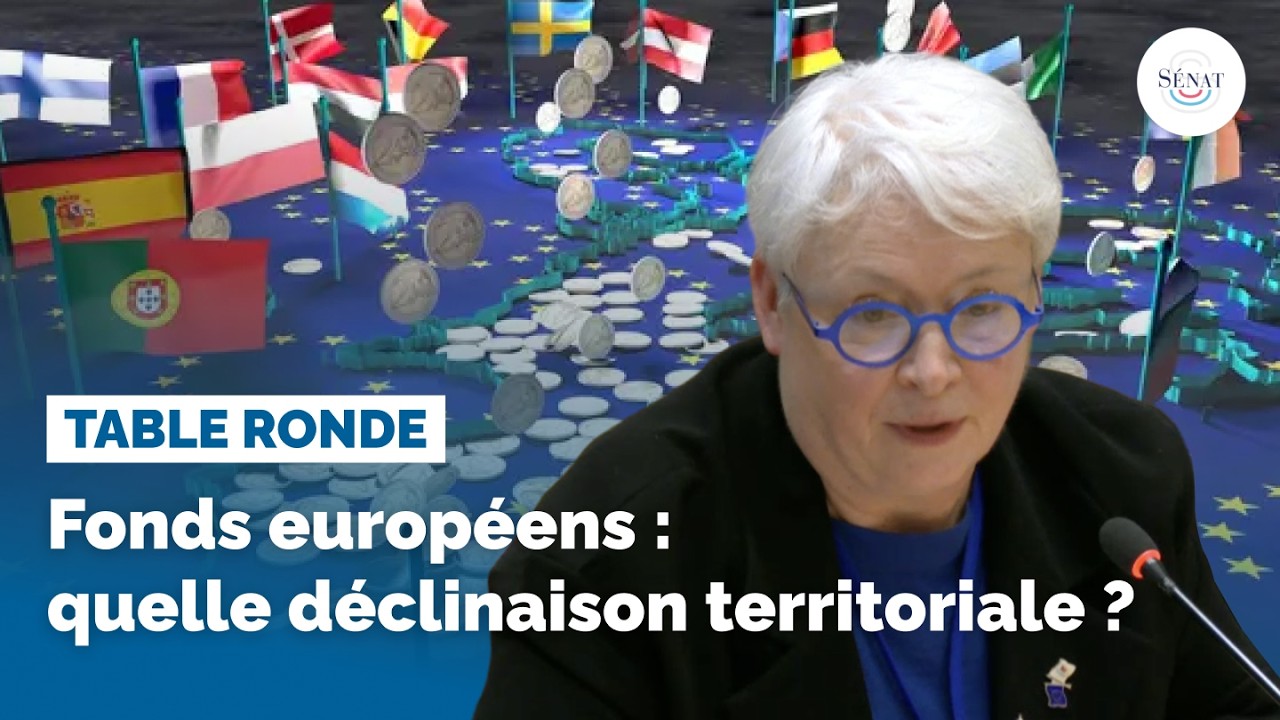
Fonds européens : quelle déclinaison territoriale ?
European Funds: What Territorial Implementation?
Keywords
Summary
361 words
Critical Evaluation
Value of the Information & Strength of the Argument
The informational value is high and unusually concrete for a parliamentary format. Within a few minutes the viewer obtains a set of hard, checkable data points: the €204 billion in cuts in the European Council President’s compromise, the €2.5 billion and €8 billion cohesion reductions compared respectively with the Commission’s initial proposal and the Irish presidency’s text, the Council’s summer position, the 5,000–6,000 parliamentary amendments, the 17 December closure of the first technical round, the June 2027 deadline for submitting plans and the January 2028 submission target. The order-of-magnitude comparison of French regional envelopes, moving from about €15.8 billion to €10–11 billion, is the single most informative element for anyone trying to understand the material stakes, and it is presented as an estimate rather than a figure. The speakers also supply genuinely operational insight that is rarely documented: the way the performance-based logic of milestones and targets changes the temporal profile of spending, pushing managing authorities towards front-loading and towards large projects that can absorb funds quickly, in the manner of the recovery plan; the risk that housing thermal renovation could absorb half of a regional envelope while concentrating benefits on large social-housing programmes in big cities; and the precedent of water-management credits that had to be reallocated because the national level did not meet the Commission’s criteria, illustrating how country-level conditionality can penalise regions that were themselves proactive. The argumentation, however, is uneven in its mode of proof. The DG REGIO intervention is descriptive and procedural, careful to state what is not yet decided, and is by far the most measured. The regional representative’s intervention is argumentative and normative: it builds a coherent causal chain — smaller budget, single pillar, CAP dominance, shorter consultation, performance targets, massification of spending, urban bias — but each link is asserted rather than evidenced, and the rhetorical register (references to the Yellow Vests, to public-service withdrawal, to territories ‘forgotten by the nation’) belongs to political advocacy rather than to demonstration. The claim that the CAP will necessarily win the intra-pillar competition is plausible and widely shared, yet it is stated as a certainty without supporting modelling. There is also an internal tension worth noting: the speaker simultaneously complains that consultation is being compressed and that envelopes are unknown, while acknowledging that the performance logic forces a strategic reorientation of project selection — a constraint that arguably requires exactly the earlier prioritisation she criticises. The session is truncated in the transcript at the moment the ANCT representative begins, so the counterweight that a national-coordination perspective would have provided cannot be assessed.
Scientific Rigor, Source Quality, Title Accuracy
No bibliography, report or written document is cited in the course of the exchanges, which is normal for an oral hearing but leaves the listener unable to check any figure independently. The only identifiable reference is an opinion of the European Committee of the Regions on cohesion policy as a driver of EU objectives and reforms, for which the speaker was rapporteur; it is named but not quoted. Everything else — the compromise texts, the Council position, the draft regulations, the French envelope estimates — is referred to by nature rather than by title, date or reference number. This does not undermine the credibility of the speakers, whose institutional positions give them direct access to the underlying documents, but it does mean the note is a source of orientation rather than of verifiable data. On the substance, the internal consistency is good: the DG REGIO and the regional representative converge on the facts (open legislative process, French regional chapters, regions as managing authorities, uncertainty over envelopes) and diverge only on interpretation and emphasis, which is exactly what one expects from a Commission-versus-region pairing. The chair plays a genuine adversarial role, putting the same question to each participant in turn and explicitly naming the risk of competition between the CAP and cohesion. A notable secondary point: the proper French pronunciation of the DG REGIO representative’s name is publicly corrected on air, and she states her Croatian origin and apologises in advance for language approximations — a detail that says something about the multilingual working conditions of these negotiations but has no bearing on the content’s reliability. As for the relationship between title and content, the title is a faithful if austere description of the session; it promises a discussion of territorial implementation and delivers exactly that, with no substantive gap between announcement and delivery.
745 words
Title / Content Match
The title matches the content exactly: the entire session is devoted to how EU cohesion policy and European funds are being territorialised, with a specific focus on the French regional chapters. It is generic but honest, announcing a question of principle rather than a scoop.
Quality & Reliability
8/10
First-hand testimony from the four institutional actors who actually negotiate and implement EU cohesion funds in France (DG REGIO, Régions de France/Committee of the Regions, ANCT, SGAE), convened by a parliamentary committee. The factual content — budget figures, legislative timetable, number of amendments, envelope estimates — is precise and attributable, but is delivered orally without a written documentary apparatus, and several figures (notably the regional envelope estimates) are explicitly presented as orders of magnitude rather than confirmed allocations. The partial transcript also prevents verification of the later exchanges and of the answers given to the questions posed.
Key Moments
Markers derived by PSI from the transcript: the creator did not define chapters.
- Opening by the committee chair: presentation of the roundtable's purpose (national implementation of cohesion policy and mobilisation of European funds for local authorities), of the four participants, and notice that the hearing is filmed and broadcast on the Senate's website and social media.
- Framing of the budgetary context: the European Council President's compromise on the 2028-2034 multiannual financial framework implies €204 billion in cuts, including €2.5 billion on cohesion relative to the Commission's proposal and €8 billion relative to the Irish presidency's text; French opposition stated and a December deadline invoked.
- Deša Srsen (DG REGIO) describes the state of play: Council position adopted in the summer, 5,000–6,000 amendments tabled in the European Parliament, no legal base yet, and technical preparatory talks with member states already under way.
- Explanation of the cascading consequences of a failure to agree on the financial framework at heads-of-state level: sectoral legislation cannot be finalised, the plans cannot be adopted, and the January 2028 submission target is at risk — with the 2021-2027 delay cited as precedent.
- DG REGIO confirms that the Commission imposes no single architecture or timetable, adapts to each member state, and welcomes France's choice of regional chapters within its national and regional partnership plans, supported by technical meetings running to 17 December.
- Isabelle Boudineau (Régions de France) opens with the regions' concern: a multiannual budget lower than the previous generation, and a single pillar merging the CAP and cohesion in which she expects the CAP to prevail, to the detriment of territorial development tools.
- Estimate of the material impact on French regions: cohesion envelopes moving from roughly €15.8 billion towards €10–11 billion, compounded by earmarking for outermost regions and for former regions such as Limousin in Nouvelle-Aquitaine.
- Analysis of the performance-based logic: milestones and targets create a decommitment risk, push regions to massify spending early in the programme in the manner of the recovery plan, and may favour large urban projects — thermal renovation of social housing being the example given.
- Governance: regions confirmed as managing authorities with regional chapters, but concern that conditionality linked to country-specific recommendations may penalise regions over reforms outside their competences, illustrated by the reallocation of water-management credits.
- The chair turns to Samuel Brossard (ANCT), asking for the 2021-2027 assessment, the agency's future role and coordination with the SGAE, the feasibility of the June 2027 deadline given the French electoral calendar, and the engineering support needed by regions.
Cited Sources
- Opinion of the European Committee of the Regions — cohesion policy as an essential driver for the achievement of the EU's objectives and reforms (rapporteur: Isabelle Boudineau) — Explicitly named by the chair as the text for which the Régions de France representative acted as rapporteur; referred to by title only, without a reference number or quotation.
- European Commission proposals for the post-2027 cohesion policy regulations (national and regional partnership plans) — The DG REGIO representative refers repeatedly to the Commission's draft regulations, currently before the co-legislators and not yet adopted, as the basis on which the new plans will be built.
- Compromise proposal of the President of the European Council on the 2028-2034 multiannual financial framework — Presented by the chair as the text tabled days before the hearing, with €204 billion in cuts and specific reductions on cohesion; the figures quoted come from this proposal.
- Council position on the cohesion policy package — Cited by DG REGIO as having been agreed in summer, and as the basis for the technical preparation talks begun with member states despite the absence of a legal base.
Concurring Sources
- European Regional Development Fund — overview — Corroborates the general architecture described by the speakers: shared management, regional programmes, and the role of managing authorities designated at national or regional level.
- Multiannual Financial Framework — overview — Confirms that sectoral legislation and programme adoption are contingent on the ceiling agreed by the heads of state and government, which is precisely the cascade described by DG REGIO.
- Cohesion Fund — overview — Consistent with the distinction the speakers draw between the cohesion envelope proper and the agricultural guarantee funds with which it is being placed in a single pillar.
Contribution & Novelties
The session’s distinctive contribution is to put the four bodies that actually operate the French cohesion system in the same room and let them describe, in operational terms, how a reform that is still legally unfixed is already reshaping behaviour on the ground. The most original material lies in the mechanics rather than the politics: the description of technical preparatory talks running in parallel with legislation that may not be adopted, the point that the Commission deliberately imposes no common architecture or pace and follows each member state’s choices, and the account of how a performance-based funding model with milestones and targets silently transforms the temporal profile of spending — forcing managing authorities towards large, fast-absorbing projects in the manner of the recovery plan, with a plausible bias towards major urban programmes. Also notable is the concrete precedent of water-management credits that could not be used because the national level failed the Commission’s criteria, which turns the abstract debate on country-specific-recommendation conditionality into a documented case of misaligned incentives between state and region. The session does not, however, present new research or new data; its novelty is testimonial.
Pour aller plus loin :
- European Regional Development Fund — Background on the main instrument through which the regional envelopes discussed here are delivered.
- Cohesion Fund — Useful to distinguish the convergence-oriented fund from the regional policy instruments at stake in the negotiation.
- Multiannual Financial Framework — Explains the budgetary instrument whose December negotiation conditions the entire timetable described in the roundtable.
- European Committee of the Regions — its opinions on cohesion policy are the institutional channel through which regional positions such as those defended here are formalised.
- Performance-based / milestone-and-target funding and decommitment rules (n+2, n+3) — the mechanism at the heart of the shift the speakers describe; best approached through the relevant provisions of the cohesion regulation rather than through secondary summaries.
312 words
Radar Profile
The profile is that of an institutional hearing: high on technical density and on information quantity, driven by speakers who hold direct operational knowledge, and solid rather than exceptional on verifiability because the assertions are oral and undocumented. The reliability score is high relative to the exercise because the divergences between participants are interpretive rather than factual, and the chair deliberately confronts the positions. The lower relative mark on formal sourcing reflects the absence of any written reference, not any weakness in the substance.