European Attitudes to Basic Income: exploring women’s perspectives
Keywords
Summary
258 words
Critical Evaluation
Value of the Information & Strength of the Argument
The seminar’s main value is to bring a gender lens to a large cross-national evidence base rather than rely on normative claims about basic income. It uses nationally representative ESS data, a consistently worded basic income scenario, and multivariate logit models to separate gender from education, income, age, trust, migration status and redistribution attitudes. The argument is structured as three testable hypotheses, and the results are presented as associations rather than causal effects. The finding that women are not uniformly more supportive, and that higher-income respondents and those in higher-HDI countries are less supportive, is a useful corrective to simple narratives that treat women or poorer citizens as a homogeneous pro-basic-income bloc. The argument’s weakness is that the transcript reports signs and broad significance rather than effect sizes or marginal effects, so the practical magnitude of the gender and socioeconomic differences remains unclear. The paper is also described as preliminary, and the cross-sectional 2016/17 data cannot capture attitude change after COVID-19 or the most recent AI debates.
Scientific Rigor, Source Quality, Title Accuracy
Scientific rigour is generally good for a seminar: the European Social Survey is a well-documented, nationally representative comparative survey, the basic income question is specified in detail, the sample is large, and the model includes plausible controls. However, the presentation relies on a single survey round from 2016/17, and the transcript does not report robustness checks, standard errors, model fit or the full interaction results. The literature review is broad but largely unnamed in the transcript, so specific claims cannot be traced without the draft paper. The Human Development Index is a coarse proxy for welfare-state context and may conflate economic development with welfare institutions. Title-content fit is strong: the talk directly examines European attitudes to basic income with a women’s perspective, although much of the empirical result is a general gender comparison rather than a full intersectional analysis.
321 words
Title / Content Match
The title accurately describes the seminar: it presents ESS-based European attitudes to basic income and explicitly foregrounds women's perspectives, though the empirical core is a general gender comparison rather than a full intersectional study.
Quality & Reliability
7/10
Academic seminar based on European Social Survey Round 8 with a large comparative sample and a transparent model specification; reliability is good but limited by the preliminary draft status, the single survey round and the limited reporting of diagnostics and effect sizes in the transcript.
Key Moments
Markers derived by PSI from the transcript: the creator did not define chapters.
- Host introduces Micheál Collins and the NERI seminar on European attitudes to basic income.
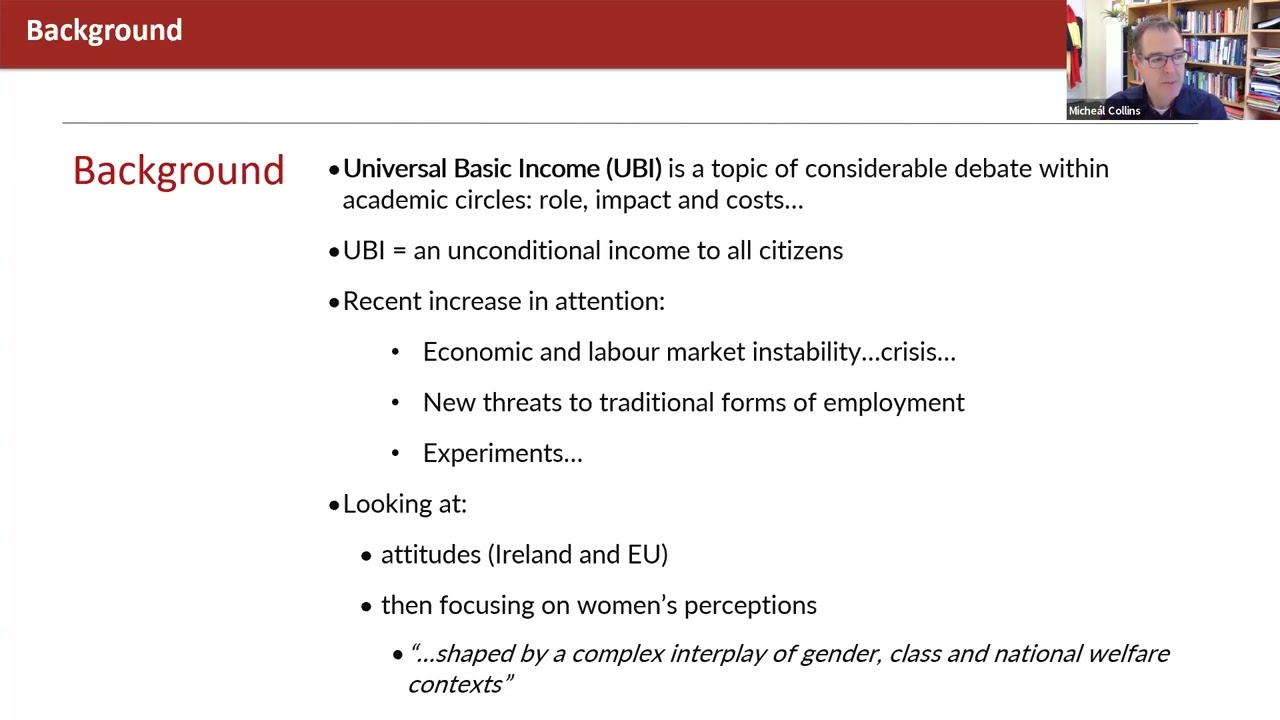
- Collins frames universal basic income as an unconditional income floor and explains renewed interest after successive economic shocks and labour-market change.
- Reviews the literature: earlier positive claims about recognising unpaid care and boosting women's autonomy, later feminist critiques about reinforcing traditional roles.
- Sets out three hypotheses: women more supportive; lower socioeconomic status more supportive; weaker welfare states more supportive.
- Explains the ESS Round 8 welfare attitudes module, 2016/17, 21 countries, and reads the basic income question wording.
- Reports headline support: about 54% in favour across ESS countries and about 57% in Ireland; notes gender differences in Ireland and cross-country variation.
- Presents the country-by-country gender breakdown: Portugal, Ireland and the UK show men more supportive; Hungary and Slovenia show women more supportive.
- Describes the logit model, dependent variable and controls including education, income, age, trust, migration status, redistribution attitudes and HDI.
- Reports model results: female gender, older age, higher income position and higher HDI are negatively associated with support for basic income.
- Closes with planned next steps, the draft public policy paper and the relevance of the findings for Ireland.
Cited Sources
- European Social Survey (ESS), Round 8 — Welfare Attitudes module — Principal data source: 21 countries, 2016/17 welfare attitudes module including the basic income question; n=26,957 in the model.
- United Nations Human Development Index (HDI) — Macro-level control for economic development and welfare-state context in the logit models.
- Collins & Li draft paper, 'European Attitudes to Basic Income: exploring women’s perspectives' — Presented at the NERI seminar; described as a draft public policy paper expected in early 2027.
Contribution & Novelties
The original contribution is a gender-focused, cross-national analysis of attitudes to universal basic income using a large representative European survey. Rather than assuming that women are uniformly more supportive, the paper tests that claim against socioeconomic status and welfare-state context. It finds that, controlling for other factors, female gender is negatively associated with support, and that higher income position and higher national HDI are also negatively associated with support. This complicates simple distributive narratives and suggests that attitudes are shaped by a complex interplay of gender, class and national welfare context.
Pour aller plus loin :
- European Social Survey — official comparative survey and data portal; useful for inspecting the welfare attitudes module and country-level results.
- Universal basic income — overview of definitions, debates and pilot experiments relevant to the seminar’s framing.
- Human Development Index (UNDP) — macro development measure used here as a welfare-state proxy; useful to compare with alternative social-policy indicators.
- Feminist critiques of basic income and unpaid care, without URL if uncertain — directly relevant to the literature split between recognition/autonomy arguments and role-reinforcement critiques.
178 words
Radar Profile
The profile is strongest on information quality and reliability, supported by representative survey data and a clear model. Technical level is solid but not advanced, since the talk explains the logit intuitively rather than reporting full estimates. Information quantity is moderate because the presentation is short and the transcript omits detailed results and discussion.