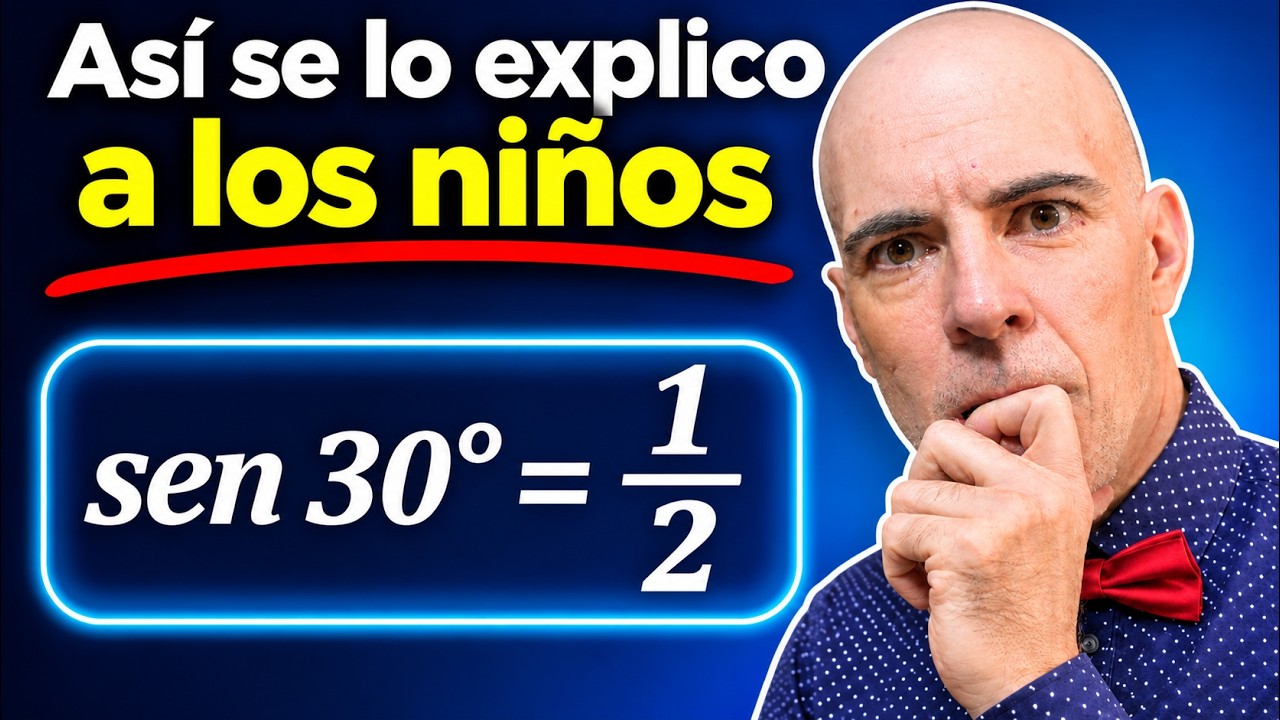
Por qué senode 30 es 1/2. Te enseño como se lo explico a los niños
Why is the sine of 30 equal to 1/2? I'll show you how I explain it to children.
Keywords
Summary
272 words
Critical Evaluation
Value of the Information & Strength of the Argument
The informational value is genuine but deliberately modest: the video replaces a memorised identity with a short, reconstructible proof, which is precisely the pedagogical gap it targets. The argument chain is tight and complete — definition of the six ratios, identification of the sine, choice of a 30-60-90 triangle, mirror symmetry, deduction of an equilateral triangle, equality of sides, and a final substitution into the definition. Each step follows necessarily from the previous one, and the choice of hypotenuse = 1 is explicitly justified as a simplification rather than presented as a general truth, which is a sound move. The geometric core is fully self-sufficient: no external result is invoked without being constructed on screen. Two weaknesses limit the argument’s reach. First, the video stops at the particular case and never indicates that the same construction generalises, nor does it connect the result to the unit-circle definition of the sine, which would have consolidated the meaning of the function. Second, the passage on the bounds of the sine (between -1 and 1) is asserted rather than argued, and sits somewhat awkwardly inside an otherwise deductive sequence. The proposed exercise on cos 30° is well chosen — it is the natural continuation of the same figure — but no hint or scaffolding is given, and its solution lies outside the video. Overall the argumentation is correct, economical and honest about what it demonstrates, without claiming any originality beyond the pedagogical presentation.
Scientific Rigor, Source Quality, Title Accuracy
Scientifically, the content is rigorous: definitions are stated correctly, the construction is valid, and no approximation or shortcut is passed off as a proof. The level of rigour is that of a well-executed elementary geometry lesson, with no overreach. On sources, however, the video cites no external authority — no textbook, no historical or institutional reference — and every link in the description points to the author’s own channel (the solution video for the cos 30° exercise, a live session on trigonometric ratios, a complete trigonometry course, and a playlist of exercises) or to his website. These function as continuity for a course series rather than as corroboration of the claims; they are legitimate pedagogical pointers but do not constitute source verification, and the mathematical validity here rests entirely on the correctness of the on-screen reasoning. Adequation between title and content is high: the title promises an explanation of sin 30° = 1/2 as taught to children, and the video delivers exactly that demonstration, in elementary language, together with the follow-up task it announces.
429 words
Title / Content Match
The title announces a step-by-step justification of sin 30° = 1/2 presented in elementary terms, and that is exactly what the video delivers, including the proposed extension to cos 30°.
Quality & Reliability
7/10
The mathematical claim and its proof are standard and correct: the six trigonometric ratios are defined on a right triangle, and sin 30° = 1/2 is derived by mirroring a 30-60-90 triangle to obtain an equilateral triangle, whose three equal angles force equal sides, so the side opposite the 30° angle equals half the hypotenuse. The reasoning is self-contained, uses only elementary geometry, and contains no computational error. The main limits are the absence of any external or textbook reference, links that point exclusively to the author's own lessons, and a very condensed treatment with no discussion of generalisation to other angles or of the unit-circle definition.
Chapters
- ¿Por qué sen 30° = 1/2?
- Las seis razones trigonométricas
- ¿Qué significa el seno de un ángulo?
- DEMOSTRACIÓN DE QUE SEN 30° = 1/2
- Construcción del triángulo rectángulo
- Utilización de la simetría
- Obtención del triángulo equilátero
- Cálculo del cateto opuesto
- Demostración final
- Ejercicio propuesto y material de mis clases
- TAREA PARA TI: DEMUESTRA QUE COS 30° = √3/2
- ¿Qué significa el coseno de un ángulo?
- Más clases de trigonometría
Cited Sources
- Solution of the exercise: why cos 30° = √3/2 — Follow-up lesson offered to viewers who want to check the exercise proposed at the end of the video.
- Trigonometric ratios from scratch — sine, cosine, tangent and worked exercises — Live session presenting the trigonometric ratios in a single lesson with practical exercises.
- Complete trigonometry course from scratch — Full course series to which this lesson belongs.
- Playlist — Trigonometry problems — Collection of exercise videos complementing the lesson.
- Matemáticas con Juan — official website — Author's site, referenced as the hub for his course material.
Concurring Sources
- Trigonometric functions — Wikipedia — Confirms the definition of the sine as opposite side over hypotenuse and the exact value sin 30° = 1/2.
- Special right triangles — Wikipedia — Confirms the 30-60-90 side ratios, including the hypotenuse being twice the side opposite the 30° angle.
- Equilateral triangle — Wikipedia — Confirms that an equilateral triangle has three 60° angles and three equal sides, the property used to close the proof.
Contribution & Novelties
The video makes no claim to new knowledge and adds nothing to the mathematical record: sin 30° = 1/2 is a classical result, and the mirror-symmetry proof via the equilateral triangle is a long-established classroom demonstration. Its contribution is pedagogical rather than scientific — it reconstructs the result from first principles on screen with a single figure, refuses the formula-and-calculator route, and frames the answer as something a learner can rebuild rather than recall. The most transferable idea is the deliberate normalisation of the hypotenuse to 1, which turns a general ratio into a readable length comparison and prefigures the unit-circle approach without naming it.
Further reading:
- Trigonometric functions — Situates the sine defined here on a right triangle within the broader function and unit-circle framework the video leaves aside.
- Special right triangles — Covers the 30-60-90 triangle used in the demonstration and gives the side ratios, including the cos 30° = √3/2 result left as an exercise.
- Equilateral triangle — Formalises the property that equal angles imply equal sides, the step on which the whole proof rests.
- Unit circle — The natural generalisation of the author’s choice of a hypotenuse of length 1, and the standard setting for extending the result to all angles.
- Law of sines — the general trigonometric relation of which this special case is a particular instance; cited by name only, as no single canonical page can be guaranteed.
234 words
Radar Profile
The profile is markedly asymmetrical: technical level and quantity of information are low by design, while quality and reliability of the mathematical content are solid, reflecting a short focused lesson rather than a broad survey. The dip in quantity is not a defect of accuracy but the consequence of a single-question format treated in about ten minutes, with part of that time devoted to promotion and to pointers towards other lessons.