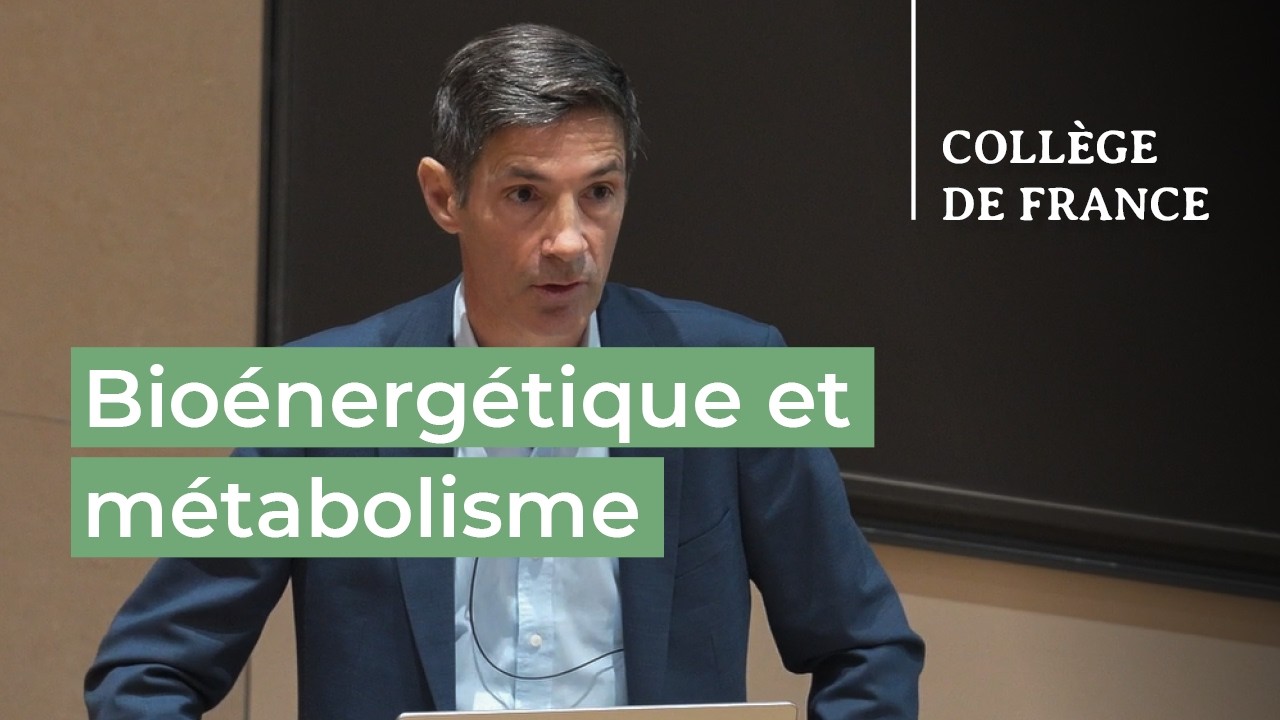
Le vivant hors d’équilibre - 2026-27 (2)
The Living Outside Equilibrium - 2026-27 (2)
Keywords
Summary
329 words
Critical Evaluation
Value of the Information & Strength of the Argument
The informational value of this session lies in the construction of a usable conceptual scaffold rather than in the delivery of new data. Lecuit spends real time on definitions — what equilibrium actually means (uniform temperature and pressure, concentrations stable in time, no currents, detailed balance, no arrow of time) — before using the term, which is precisely what allows the subsequent distinctions to carry weight. The classification he proposes (equilibrium; closed system displaced and relaxing; open system held stationary by boundary conditions; living system driven locally at the nanometric scale) is the operational core of the lecture, and it is stated in a way that makes it falsifiable and testable rather than rhetorical. The argument that follows is deductive: conservation of energy is shown to be insufficient to explain unidirectional metabolic fluxes, which motivates the introduction of the second law and of Gibbs free energy, which in turn explains relaxation towards a free-energy minimum while total entropy rises. The most original argumentative move is the scale-and-timescale reasoning used to justify why equilibrium statistical mechanics nevertheless succeeds in gene regulation and morphogenesis: binding and unbinding constants below one second against transcription and tissue deformation over tens to hundreds of seconds, with explicit orders of magnitude (RNA polymerase II at roughly 1.2 kb per minute, epithelial elongation by a factor of nearly two in under an hour). The reasoning is honest about its own frontier: Lecuit states plainly that the quantitative characterisation of metabolic fluxes is still at an early stage and that measuring them is technically difficult, which is a mark of argumentative integrity rather than a weakness. The weaker passages are where the argument moves by assertion rather than demonstration — the claim of a violation of detailed balance in living systems is stated as an emergent property without derivation in the transcribed portion, and the transitions between the thermodynamic core and the biological examples are sometimes carried by analogy (convection cells, cyclones) whose illustrative power exceeds their evidential weight. The lecture also handles a classic tension well: it does not pretend that the second law is suspended in organisms, but reframes order as compatible with it through local entropy production in an open system, a point Lecuit links explicitly to Schrödinger’s formulation.
Scientific Rigor, Source Quality, Title Accuracy
Scientific rigour is high and the sourcing is essentially oral. The lecture is anchored in canonical thermodynamics — Clausius for the second law, Gibbs for free energy, Boltzmann for the statistical weights — and quotes Schrödinger’s What is Life? verbatim in English rather than paraphrasing it, which is good practice when a formulation is being made to carry an argument. The only primary research result shown is from the speaker’s own team (epithelial intercalation and tissue elongation), and he explicitly signals that this is his own work and that he cites it rarely, which removes any ambiguity about provenance. What is missing is displayed citation: no references, no figures with source lines, no indication of which papers underpin the gene-regulation thermodynamics discussion, described only as an abundant literature. Some statements are hedged in ways that reveal appropriate epistemic caution (the mantle viscosity recalled from undergraduate geology, an audience anecdote about a Joule-type experiment on a falling water drop, which Lecuit reports as hearsay rather than fact). No advertising sequence is present in the recording. On title adequacy: the announced object — the living being out of equilibrium — is the object actually treated, with the ‘(2)’ marker corresponding to the recap of the previous session; the fit is strong, with the caveat that some biological examples are announced as belonging to subsequent sessions.
612 words
Title / Content Match
The title announces a treatment of living systems as out-of-equilibrium systems, and that is exactly what the lecture delivers: equilibrium, closed displaced systems, forced open systems, then the specific local molecular non-equilibrium character of cells. The '(2)' marker matches the explicit recap of the previous session at the opening.
Quality & Reliability
9/10
Lecture delivered by a chair professor at a major research institution, within a structured annual course whose previous session is explicitly recapped. The conceptual chain (first law → second law → Gibbs free energy → dissipative structures → locally driven living systems) is laid out explicitly, with definitions given before use and orders of magnitude quoted when an approximation is made. The speaker flags his own uncertainty where it exists (mantle viscosity 'if I remember my geology courses', an anecdote about a Joule-type drop experiment attributed to an audience member) and presents work from his own team while saying openly that he rarely cites it. No commercial interest, no advertising sequence in the recording. Limits: citations are oral only (Clausius, Gibbs, Boltzmann, Schrödinger) with nothing displayed on screen, and several quantitative claims about entropy production rates are announced for later sessions rather than demonstrated here.
Key Moments
Markers derived by PSI from the transcript: the creator did not define chapters.
- Recap of the previous session: universal equivalence between mechanical work and heat at 4.186 J per calorie, conservation of energy, and the falsification of vitalism.
- Energy conversion at the nanometric scale: mechanical, electrostatic and thermal energies all of order a few kT, exploited by molecular motors; asymmetric energy landscapes as the source of irreversibility.
- Insufficiency of the first law for unidirectional metabolic fluxes; the second law, Clausius's statement, and the introduction of Gibbs free energy G = H − TS.
- Definition of equilibrium: uniform temperature and pressure, stable concentrations, no currents, detailed balance, and therefore no arrow of time.
- Open systems in forced stationary states: Rayleigh–Bénard convection, lake ice patterns, cyclones and mantle convection driving plate tectonics.
- What distinguishes the living system: local non-equilibrium at the nanometric scale, broken detailed balance, emergent chemical cycles and active matter.
- Steady internal parameters (ATP concentration) versus static equilibrium; the open challenge of a quantitative theory of fluxes and their measurement.
- Long quotation from Schrödinger's What is Life? on the transition from the living to the dead state and the role of exchange with the environment.
- Equilibrium statistical mechanics applied to transcription-factor binding: Boltzmann weights, partition function, energy landscapes of binding sites and predicted occupancy.
- Tissue mechanics: anisotropic cortical tension drives cell intercalation and the near-doubling of tissue length in under an hour.
Cited Sources
- Collège de France — course cycle 'Bioénergétique et métabolisme' (2026-2027) — Official page of the course cycle to which this session belongs, given in the video description.
- Collège de France — Chair 'Dynamiques du vivant', Pr Thomas Lecuit — Institutional page of the speaker's chair, referenced in the description.
- YouTube playlist — all lectures by Thomas Lecuit — Playlist collecting the full teaching cycle, allowing this session to be placed in sequence.
- Erwin Schrödinger, What Is Life? (1944) — Quoted verbatim in English to characterise the living state as continued exchange of matter and energy with the environment; no edition is specified in the lecture.
- Rudolf Clausius — formulation of the second law — Quoted in German ('Die Entropie der Welt strebt einem Maximum zu') as the macroscopic statement needing a system-level counterpart.
- Josiah Willard Gibbs — free energy G = H − TS — Introduced as the system-level quantity that makes the second law operational for an organism at constant pressure; the speaker notes the French terminology ('enthalpie libre') and prefers 'Gibbs free energy'.
- Lecuit team work on epithelial cell intercalation and tissue elongation — Time-lapse result presented in the final part of the lecture, explicitly attributed by the speaker to his own group; no reference or URL given in the description.
Concurring Sources
- Second law of thermodynamics — Standard reference corroborating the entropy-production and irreversibility framework recalled in the lecture.
- Gibbs free energy — Supports the statement that spontaneous evolution at constant pressure and temperature minimises G.
- Rayleigh–Bénard convection — Corroborates the description of convection cells produced by a temperature gradient across a fluid layer.
- Dissipative system — Corroborates the notion of structure maintained by continuous energy dissipation under boundary constraints.
- Detailed balance — Provides the formal definition of the equilibrium property whose local breaking the lecture attributes to living systems.
- Boltzmann distribution — Supports the use of Boltzmann weights and partition functions to compute transcription-factor occupancy.
External References
Contribution & Novelties
The value here is synthetic and pedagogical rather than the report of a new discovery. Lecuit articulates, in a single continuous argument, a thermodynamic classification of systems (equilibrium, closed-displaced, forced open, locally driven living) with the concrete scales at which cell biology operates, and in doing so replaces the vague phrase ’living systems are far from equilibrium’ with a specific claim: the departure from equilibrium in a living system is imposed locally, at the nanometric scale of bond transactions, and it manifests macroscopically as broken detailed balance, chemical cycling and persistent entropy production. The second original contribution is the explicit justification, in orders of magnitude, of why equilibrium statistical mechanics can legitimately be used for gene regulation and tissue mechanics: the fast molecular binding events (under a second) are averaged out over the slow macroscopic processes (tens to hundreds of seconds), so the system behaves as if equilibrated at the larger scale. This timescale-separation argument is what makes the equilibrium treatments of transcription-factor occupancy and of epithelial mechanics principled rather than merely convenient, and it is presented together with a clear statement of what remains unsolved: a quantitative theory of metabolic fluxes and, above all, their experimental measurement.
Pour aller plus loin :
- Dissipative system — The concept underlying the forced stationary structures (convection cells, cyclones) used as the non-living foil to the living system.
- Rayleigh–Bénard convection — The canonical experimental case discussed for boundary-imposed gradients producing organised patterns.
- Detailed balance — The equilibrium property whose local violation the lecture presents as the signature of living matter.
- Gibbs free energy — The quantity G = H − TS through which the second law is made operational at the level of the organism.
- Active matter — The physics framework for materials made of energy-consuming components, invoked for cytoskeletal and collective cell dynamics.
- Boltzmann distribution — The statistical weight exp(−E/kT) used to predict transcription-factor occupancy from binding energies.
- What Is Life? — Schrödinger’s 1944 essay, quoted in the lecture on the difference between the living and the dead state.
337 words
Radar Profile
The profile is broad and high across all four axes: a dense, technically demanding lecture that nevertheless scores high on information quantity because definitions, scales and mechanisms are supplied together rather than alluded to. Reliability matches technical level, reflecting an institutional research context with explicit hedging where the speaker is uncertain. The only axis that would fall short of the maximum is formal demonstration, since several quantitative claims on flux measurement and local detailed-balance breaking are announced for later sessions rather than derived here.