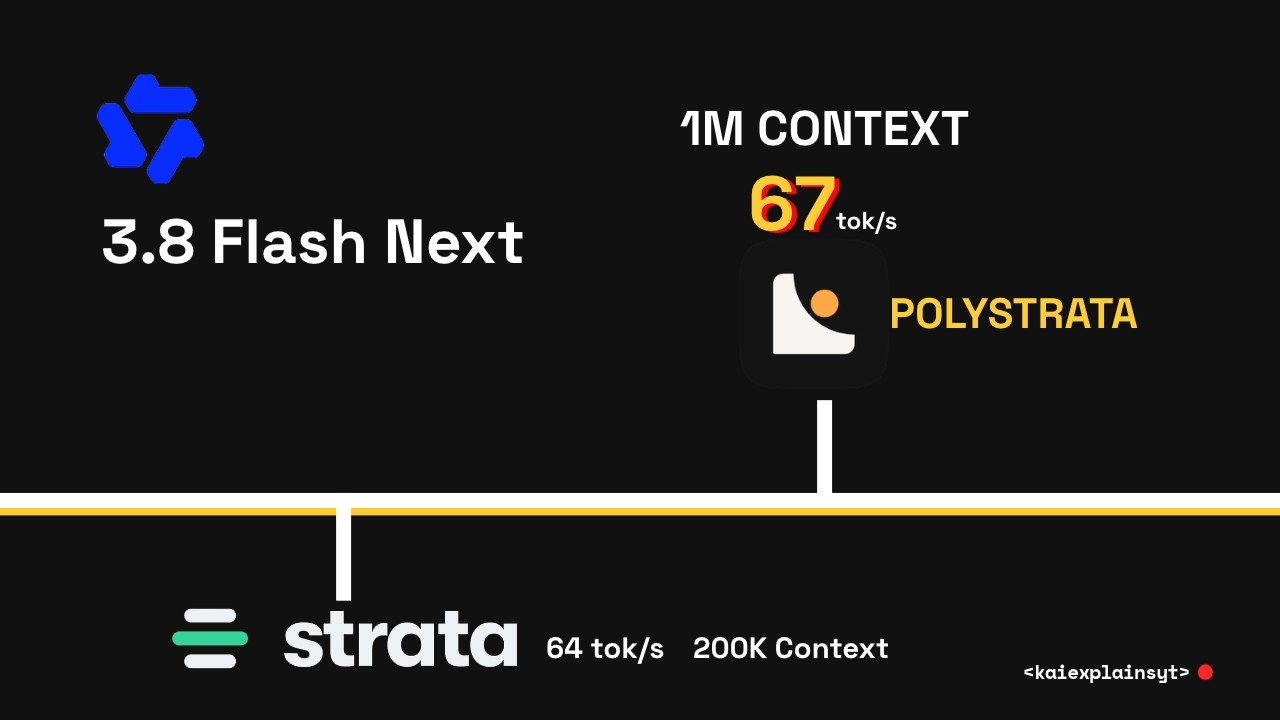
PolyStrata Runs Qwen at 67 Tokens/s With 1M Context
Keywords
Summary
329 words
Critical Evaluation
Value of the Information & Strength of the Argument
The informational value lies less in the headline figure than in the decomposition around it. The video separates two quantities that marketing routinely merges — decode throughput and prefill latency — and shows that the impressive 67 tokens/s applies only to the phase that occupies under 2% of wall-clock time at full context. That reframing is then made operational through three concrete decompositions: the layer-level explanation of why decode stays flat (fixed-size summaries in 36 of 48 layers, selective reread of ~2,000 tokens in the other 12), the memory accounting that attributes ~13 GB to a million-token KV cache against a peak of ~121.5 GB, and the cache-hit economics that turn a four-minute read into a six-second session restore. The twenty-questions worked example (81 minutes versus roughly four minutes on identical hardware and identical model file) is the strongest single piece of value in the video, because it converts an abstract percentage into a decision-relevant quantity and isolates the only variable that matters: whether the cache survives between questions. The estimation of 15 cents of hosted input cost against roughly half a cent of electricity, set against $8,000 of hardware, is a further useful translation into economic terms, even if it deliberately ignores amortisation and output pricing.
The argumentation is disciplined in structure but dependent on rhetorical cushioning. Its strongest move is triangulation: the prefill figure is not taken on faith but reconstructed arithmetically, checked against the report’s own internally inconsistent 3,000 tokens/s statement, and then cross-validated against a second tester on a different machine and different quantised file, which converges on ~4,100 tokens/s and 244 s. The presenter also uses the report’s own back-to-back half-million-token runs (70.9 versus 74.0 tokens/s, a 4.4% spread on identical hardware) as an internal calibration of noise, which correctly deflates claims of a 6.7% generational improvement derived from one run each. He states plainly that nothing was rerun, that one run is a sample of one, and that the hardware was deliberately power-capped at 450 W rather than the 575 W default — a caveat that cuts in favour of the result rather than against it. The weaker links are the places where inference substitutes for evidence: the missing YaRN flag is treated as a genuine open question but then used to raise a broader worry about users over-stretching models, which the report cannot confirm; the claim that a 5-bit file predicts the full-precision output 93-95% of the time is asserted without visible evaluation at long context; and the 25-question quiz is dismissed as vibes-based, correctly, but leaves the accuracy question the video itself raised unanswered. The 3-bit versus 5-bit throughput difference is attributed to expert residency (96-98% versus 82%) with a mechanism that is plausible and probably correct for a 512-expert MoE, but is reconstructed by the presenter rather than quoted from a controlled test. The overall reasoning is honest, arithmetically transparent and unusually willing to flag its own uncertainty; it is limited by the evidence base it inherits rather than by how it handles it.
Scientific Rigor, Source Quality, Title Accuracy
The sourcing is unusually traceable for the genre. Every quantitative claim is anchored to a named artefact: the November 3 bench-results folder keyed to an RTX 5090 running UD-Q5_K_XL, PolyStrata pull request #131, the PolyStrata README and model page, the community benchmarks file, the two October Strata bench-results folders, Strata’s DETAILS.md and RESEARCH_RUNS.md, the Qwen3.8-Flash-Next model card and Unsloth’s GGUF repository, plus two third-party write-ups and a public social post. All of these are linked in the description, which makes independent checking feasible in a way that a narration-only review is not. The channel is explicit that it re-ran nothing and that the report is a single run logged as a pull request, and it declines to name a figure it cannot pin down rather than smoothing it over. It also does the less common thing of exposing a contradiction inside the source it is reading: the stated ~3,000 tokens/s prefill rate implies roughly 329 s, which is incompatible with the 243.5 s time-to-first-token in the same document, and the presenter says outright that one of the two must be mislabelled. That is a genuine finding rather than a rhetorical flourish, and the cross-check against a second tester’s ~4,100 tokens/s / 244 s result is the correct way to arbitrate. The main gaps are structural rather than careless: no independent benchmark was run, no controlled comparison of YaRN on versus off at short context exists in the cited material, and the accuracy claims rest on vendor figures rather than on the test machine. The claim that this model runs on the original Strata engine is sourced to the fork’s own README, which is about as strong as such a claim can get without access to the build logs, and the commit-count comparison (roughly 7,000 versus just over 1,000) is a reasonable proxy for attribution, though commit counts are a crude measure of contribution. Attribution of defaults — an 8 GB conversation parking space against a 13.4 GB requirement, per-session duplication in parallel agents — comes from single testers and is presented as such but would benefit from a second source.
On title adequacy, the framing is technically accurate and substantially incomplete. PolyStrata did run Qwen at 66.8 tokens/s at a million tokens of context, so nothing in the title is false. But the title promotes the number the video spends most of its runtime contextualising, attributes the run to the fork whose role the video explicitly downgrades, and omits the four-minute prefill that the whole analysis identifies as the real cost. That said, the video is openly a corrective reading of that exact headline, so the title functions as the claim under examination rather than as the video’s own conclusion.
968 words
Title / Content Match
The title restates the headline number and the tool name faithfully, but it inherits the framing the video itself spends thirty minutes qualifying: the fork is credited for a run its own documentation attributes to the original Strata engine, and the 67 tokens/s figure omits the four-minute prefill that dominates the wait. The content is a contextualising debunk of exactly that headline, so the mismatch is a hook rather than a false promise.
Quality & Reliability
7/10
The video is built almost entirely on primary, checkable artefacts: the November 3 benchmark folder, PolyStrata pull request #131, the PolyStrata and Strata repositories and their documentation, the Qwen model card and the Unsloth GGUF page, plus a handful of public third-party test write-ups. The presenter explicitly states that nothing was re-run by the channel and repeatedly labels the run as a sample size of one. He surfaces an internal contradiction in the report (a stated ~3,000 tokens/s prefill rate that cannot coexist with the 243.5 s time-to-first-token) and resolves it by triangulating against a second, independent tester on the same CPU/GPU combination, landing on ~4,100 tokens/s. Weak points remain: the absence of a YaRN stretch flag is inferred from a logged command rather than confirmed by the authors, several defaults (8 GB conversation parking space, 96-98% versus 82% expert residency, 55 s per-question penalty on the standard chat endpoint) rest on single-tester reports, and the accuracy trade-off between 5-bit and 3-bit quantisation is left explicitly untested. Some arithmetic is rounded in speech ('about 12 to 13 GB', 'roughly 121.5 GB') and read aloud imperfectly. Overall a careful, well-sourced but second-hand reading of one data point.
Chapters
Cited Sources
- The Nov 3 report (RTX 5090, UD-Q5_K_XL) — PolyStrata bench-results — The single run at the centre of the video: 66.8 tokens/s generation, 243.5 s time-to-first-token on just over one million tokens, 450 W power cap. Source of the internally inconsistent ~3,000 tokens/s prefill figure.
- PolyStrata pull request #131 — The logged pull request through which the benchmark was submitted on November 3; treated as the primary record and as evidence that it is one run, not a suite.
- PolyStrata — repository — Used for the attribution analysis: the README, the model support list and the commit history showing the fork building on the original Strata engine.
- PolyStrata — Qwen3.8-Flash-Next model page — Cited for installer and model-file sizes, including the ~158 GB five-bit build split across six parts.
- PolyStrata community benchmarks — Aggregated third-party runs used to compare prefill times and throughput across builds and quantisation levels.
- Strata — repository — The upstream engine the presenter argues is doing the actual work for this model, released in September, with the majority of commits.
- Strata DETAILS (rope scaling, KV streaming, conversation cache) — Documentation used for the YaRN stretch behaviour, the session-wide locking of the scaling factor, and the warning that a stretched model is a slightly different model inside its native range.
- Strata, one long document and many questions (strata_prefix) — Source for the pinned-document setting that cut follow-up latency on a 64,000-token document from 48.6 s to under one second per question.
- Oct 2 1M run (needle 5/5, 36 ms warm repeat) — The earlier million-token run that predates the headline: needle-in-a-haystack 5/5 and a 36 ms warm repeat from cache.
- Oct 9 1M run (244 s read, 6.1 s SSD restore) — Independent tester on the same CPU/GPU whose ~4,100 tokens/s prefill converges with the headline run's 243.5 s, used to arbitrate the report's internal contradiction.
- RTX 5090 + 64 GB at 1M — Third-party write-up demonstrating a million-token run on a 64 GB machine by shrinking a secondary cache setting, supporting the claim that the 192 GB kit is there for the model file, not the context.
- Qwen3.8-Flash-Next model card — Source for the native 262,144-token training context, the YaRN extension to one million, and the vendor warning that stretching can degrade performance on shorter inputs.
- Unsloth Qwen3.8-Flash-Next GGUF — The quantised builds compared in the video, including the five-bit file used in the headline run and the smaller three-bit alternative that hit 94 tokens/s.
- Code Unpacked's video on this run — Another reviewer's coverage, cited as having flagged the prefill-rate inconsistency without resolving it.
External References
Contribution & Novelties
The original contribution is not the headline number but the accounting around it. The video converts a marketing figure into a phase-by-phase cost model: decode is fast because 36 of 48 layers carry a constant-size running summary and the other 12 reread only ~2,000 selected tokens per generated word, whereas prefill must push every token through every layer, so the clickbait number describes roughly 2% of the elapsed time. Three derived results are genuinely useful beyond this specific run: the memory attribution showing a million-token KV cache costs about 13 GB against a ~121.5 GB peak, which decouples RAM requirements from context length; the demonstration that cache policy, not hardware, dominates multi-question workflows (81 minutes versus about four minutes on identical hardware); and the observation that four independent million-token runs on a 5090 all sit between 244 s and 344 s, which turns a single measurement into a stable empirical envelope. The video’s second contribution is provenance: it shows, from the fork’s own README and commit history, that this model runs on the upstream Strata engine and that a million-token needle test had already been passed a month earlier, which reframes the announcement as repackaging rather than a new capability.
Further reading:
- YaRN: Efficient Context Window Extension of Large Language Models — The method behind the factor-of-four stretch needed to reach one million tokens from a 262,144-token training context, and the source of the trade-off the video flags.
- Mixture of experts (Wikipedia) — Background for the 512-expert-per-layer architecture whose expert residency on the GPU (96-98% versus 82%) explains the 3-bit versus 5-bit throughput gap.
- llama.cpp — The reference local inference stack whose prompt-cache and slot handling correspond to the eviction behaviours described here (conversation switching, parallel agents).
- Prefix caching in serving engines (concept, e.g. vLLM’s automatic prefix caching) — The server-side analogue of the pinned-document setting that turns a four-minute read into a sub-second follow-up; cited by name only.
- Sparse and native-sparse attention variants (concept, e.g. DeepSeek’s NSA line of work) — The architectural family that makes decode cost roughly independent of context length, which is the mechanism behind the flat 77.8 → 66.8 tokens/s curve.
356 words
Radar Profile
The profile is broad and relatively flat, with information quantity, information quality and technical depth clustered high: the video covers hardware, model architecture, memory accounting, cache policy and hosted-versus-local economics within one run. It dips on reliability and on quantitative completeness, because everything rests on a single logged benchmark plus third-party reports, with no re-run and no controlled test of the YaRN or quantisation variables. Overall a technically dense, self-aware reading of one data point rather than an experimental contribution.