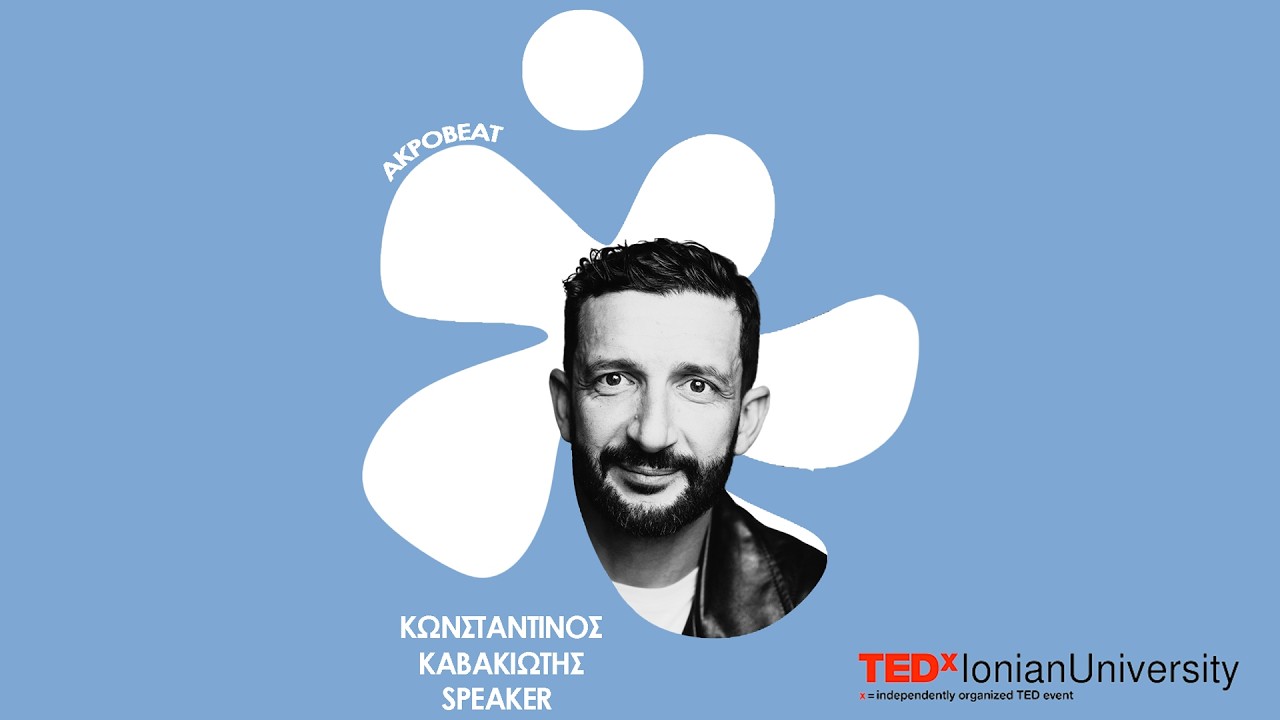
To beat or not to beat: Η δύναμη της υποκριτικής | Κωνσταντίνος Καβακιώτης | TEDxIonianUniversity
To beat or not to beat: The power of acting | Konstantinos Kavakiotis | TEDxIonianUniversity
Title history
- To beat or not to beat: Η δύναμη της υποκριτικής | Κωνσταντίνος Καβακιώτης | TEDxIonianUniversity — observed on 20261120-1642 UTC (YouTube)
Keywords
Summary
130 words
Critical Evaluation
Value of the Information & Strength of the Argument
The talk offers a refreshing perspective on acting as a universal human behavior rather than a specialized skill. The speaker’s personal anecdotes lend authenticity, and the use of historical references (Greek masks, persona) enriches the argument. However, the reasoning is largely intuitive and lacks empirical support. The appeal to common experiences (e.g., peek-a-boo) makes the message accessible, but the claim that acting is a survival mechanism remains an opinion rather than a demonstrated fact. The structure is coherent, leading from personal struggle to a broader philosophical insight about identity and obstacles.
Scientific Rigor, Source Quality, Title Accuracy
The speaker does not provide explicit sources, relying instead on widely known references such as Shakespeare’s plays and Picasso’s quote. The TEDx platform does not guarantee academic rigor. The title’s pun on ‘To be or not to be’ is creative and accurately reflects the talk’s focus on existential questions about identity and performance. While the content is engaging, the lack of verifiable citations limits its scientific reliability. No audience comments were provided to assess public reaction.
182 words
Title / Content Match
The title cleverly paraphrases Shakespeare's 'To be or not to be' and connects to the theme of acting and identity. The content aligns well with this idea, exploring how acting can reveal one's true self.
Quality & Reliability
5/10
The talk is based on personal experience and anecdotal observations rather than rigorous scientific research. It references cultural and historical concepts without providing concrete citations. The speaker is an actor and teacher, adding professional credibility but not systematic evidence.
Key Moments
Markers derived by PSI from the transcript: the creator did not define chapters.
- Speaker performs a soliloquy from Hamlet, introducing the theme of acting.
- Reflects on 18 years in London and the question 'to be or not to be' as an actor.
- Discusses the star meter rating and his 220,000th place, illustrating professional struggle.
- Describes the audition process and 'cattle calls'.
- Argues that everyone is an actor, citing infant mimicry and peek-a-boo.
- Introduces Greek masks and the concept of 'persona'.
- Uses Romeo and Juliet to explain the importance of obstacles in stories.
- Leads an interactive game and concludes with the transformative power of acting.
Cited Sources
- TEDx Talks — Official TEDx page where the talk is hosted, referenced in the video description.
Contribution & Novelties
The talk reframes acting as an essential human instinct, bridging theater and daily life. It offers a practical framework (the 5 Ws) for approaching challenges and emphasizes the role of obstacles in creating meaning. The interactive audience exercise illustrates the concept of ’truth in the moment’ as a key to authentic connection.
Pour aller plus loin :
98 words
Radar Profile
The radar profile shows low technical content and moderate information density, reflecting the anecdotal and motivational nature of the talk. Quality of information is relatively stronger than quantity, indicating thoughtful insights despite limited evidence. Overall, the talk is engaging but not scientifically robust.