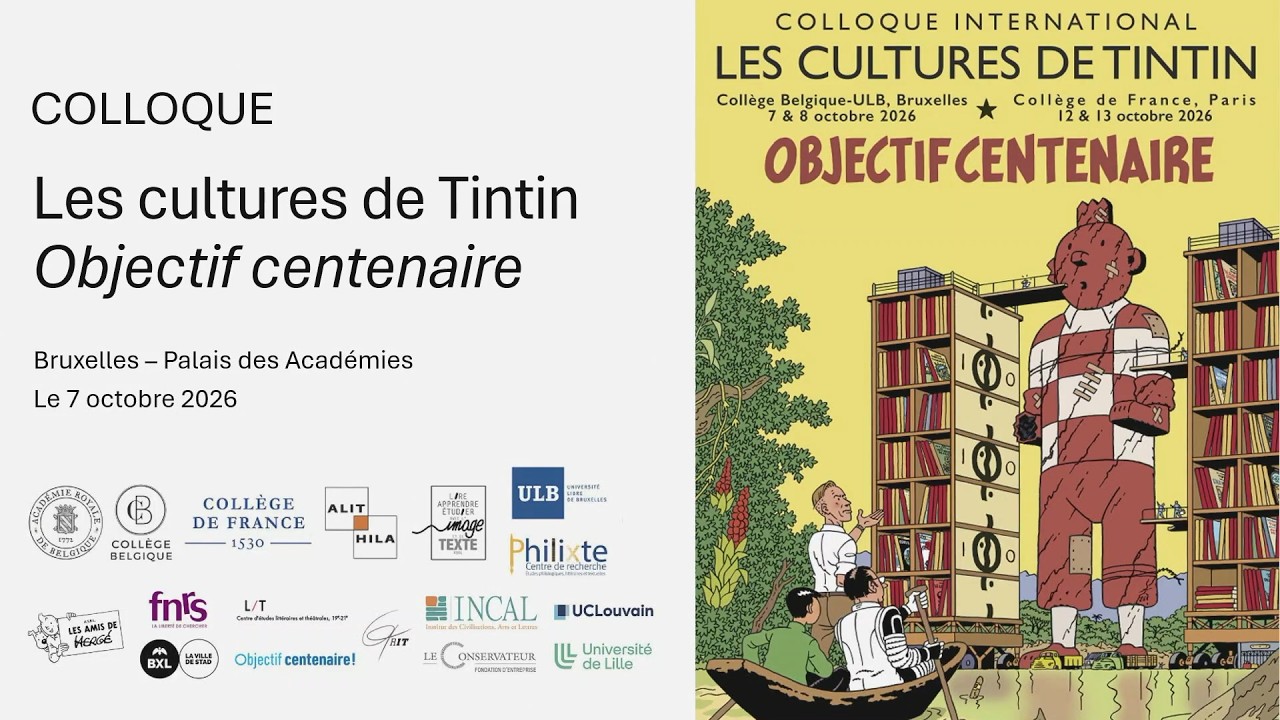
Colloque : Les cultures de Tintin. Objectif centenaire
Symposium: The Cultures of Tintin. Centenary Objective
Keywords
Summary
232 words
Critical Evaluation
Value of the Information & Strength of the Argument
The value of the excerpt lies in its clear mapping of the intellectual agenda of contemporary Tintin studies. Rather than treating Tintin as a single nostalgic object, the speakers argue for plural cultures of Tintin: commemorative, parodic, translational, artistic and academic. The presentation by Preyat and Tilleuil is the most conceptually dense part, linking the colloquium to debates about cultural legitimacy, Roland Barthes’s notion of myth, Jean-Marie Apostolidès’s work on metamorphosis, post-comics practices and the circulation of images across media. Named examples, such as Charles Burns, Sébastien Conard and Gabri Molis, give the argument concrete purchase and show how Tintin can be approached as a cultural practice rather than merely a corpus of albums. The opening remarks by Leclercq add institutional and commemorative framing, including the 1929 archival citation and the evocation of Tintin’s scientific imaginary. The argumentation is mainly expository and programmatic, as is normal for a colloquium opening: it sets out hypotheses, genealogies and programmes rather than demonstrating a single thesis. Some claims are asserted rather than argued in detail, and the spoken format leaves many references at the level of synthesis. The excerpt is therefore valuable as a map of the field and of the event’s ambitions, but it does not by itself provide the full evidence that the individual conference papers would supply.
Scientific Rigor, Source Quality, Title Accuracy
Scientific rigour is supported by the academic setting, the involvement of the Académie royale de Belgique, ULB, UCLouvain, the FNRS and the Collège de France, and by speakers who are identified as specialists or cultural actors. The transcript names scholarly works, authors and earlier conferences, which gives the discussion a visible bibliographic anchorage. However, the spoken text does not provide footnotes, page references or full publication data, and the description supplies institutional logistics rather than a bibliography. Several assertions would need to be checked against the published proceedings or the cited monographs. The quality of sources is therefore credible but not fully transparent in the recording itself. The title is adequate: it announces a colloquium on the cultures of Tintin in the run-up to the centenary, and the sampled segment remains within that frame. The only limitation is that the available transcript covers the opening and the beginning of the first conference, so the title’s broad promise cannot be assessed against the whole three-hour event.
397 words
Title / Content Match
The title accurately announces a colloquium on the plural cultures of Tintin ahead of the 2029 centenary; the sampled segment matches this framing through institutional, literary and reception-history discussions.
Quality & Reliability
8/10
Academic institutional colloquium with named specialists, explicit bibliographic references and prestigious partners. The recording is a spoken event rather than a peer-reviewed publication, and the available transcript covers only the opening sessions, so the assessment is based on a partial sample.
Key Moments
Markers derived by PSI from the transcript: the creator did not define chapters.
- Opening remarks by Jean Leclercq, framing the colloquium around Tintin's 2029 centenary and the academy's partnerships.
- Fabrice Preyat and Jean-Louis Tilleuil present the scientific problem: plural cultures of Tintin, legitimacy, myth and post-comics.
- Jacques Langlois begins his conference on the prehistory of tintinology, from fan quizzes to the 1959 publication of Le Monde de Tintin.
- Inaugural conference by Thierry Bellefroid on Hergé and Jacobs and the question of a 'clear line'.
- Remarks by Frédérick Ceulemans, alderman of the City of Brussels.
- Jean-Jacques De Gheydt on the Brussels dialect in Tintin albums.
- Remarks by Philippe Close, Mayor of Brussels.
- Round table on Hergé's Brussels legacy with Daniel Couvreur, Philippe Geluck and Pierre Kroll, moderated by Pierre Marlet.
Cited Sources
- Collège Belgique — Académie royale de Belgique — Institutional host and event page cited in the video description.
- Collège Belgique 2026 conference playlist — Playlist of related Collège Belgique lectures provided in the description.
- Paul Vandromme, Le Monde de Tintin (1959) — Presented by Jacques Langlois as a founding moment of serious tintinology.
- Olivier Roche, Tintin bibliography of a myth (2025 edition) — Cited by Fabrice Preyat as evidence of the abundance of monographic work on Tintin.
- Benoît Peeters, Collège de France chair of artistic creation, 2022–2023 — Mentioned as a sign of the academic legitimation of comics and Hergé.
- Tintin aujourd'hui: image et imaginaire — Collective volume linked to the 2017 Tintin au 21e siècle conference, cited as a precedent for the colloquium.
- Roland Barthes, Mythologies — Referenced in the discussion of Tintin as a contemporary myth.
Concurring Sources
- Collège Belgique 2026 conference playlist — Official playlist confirming the institutional context of the recorded colloquium series.
Contribution & Novelties
The originality of the event is curatorial and conceptual rather than empirical: it brings together academic exegesis, fan culture, institutional commemoration and artistic appropriation around the plural idea of ‘cultures of Tintin’. The excerpt shows a deliberate attempt to move beyond both celebratory tintinophilia and purely textual interpretation, treating Tintin as a visual factory of social imaginaries and as a case study in the changing legitimacy of comics. The emphasis on post-comics, translation, collecting, conservation and parody gives the colloquium a contemporary research agenda rather than a merely nostalgic one.
Further reading:
- Tintin — General reference on the corpus and its cultural reception.
- Hergé — Author reference for the biographical and artistic context.
- Bande dessinée — Context on the medium whose academic legitimation is central to the discussion.
- Benoît Peeters — Scholar and writer whose Collège de France lectures are cited in the video.
- Paul Vandromme, Le Monde de Tintin (1959), without URL — Early landmark in serious Tintin criticism discussed by Jacques Langlois.
164 words
Radar Profile
The radar shows a high information load and strong reliability, with a technicality appropriate to an academic humanities colloquium rather than to a technical or experimental field. The profile is limited by the partial transcript, which covers only the opening and the first conference.